Features
Behind the shot: “Night at the Sanatorium”
To get the blog off to a strong start, I am launching a series of articles explaining how we created some of the photographs in my gallery…
 By Julio Castro4 min read
To get the blog off to a strong start, I am launching a series of articles in which I will explain as clearly as possible how we created some of the photographs in my gallery. I will cover different kinds of photographs, but focus mainly on light painting which usually requires more preparation and often several people working together to create the photograph in a single exposure.
EXIF: 30 seconds – f/2.8 – ISO 640
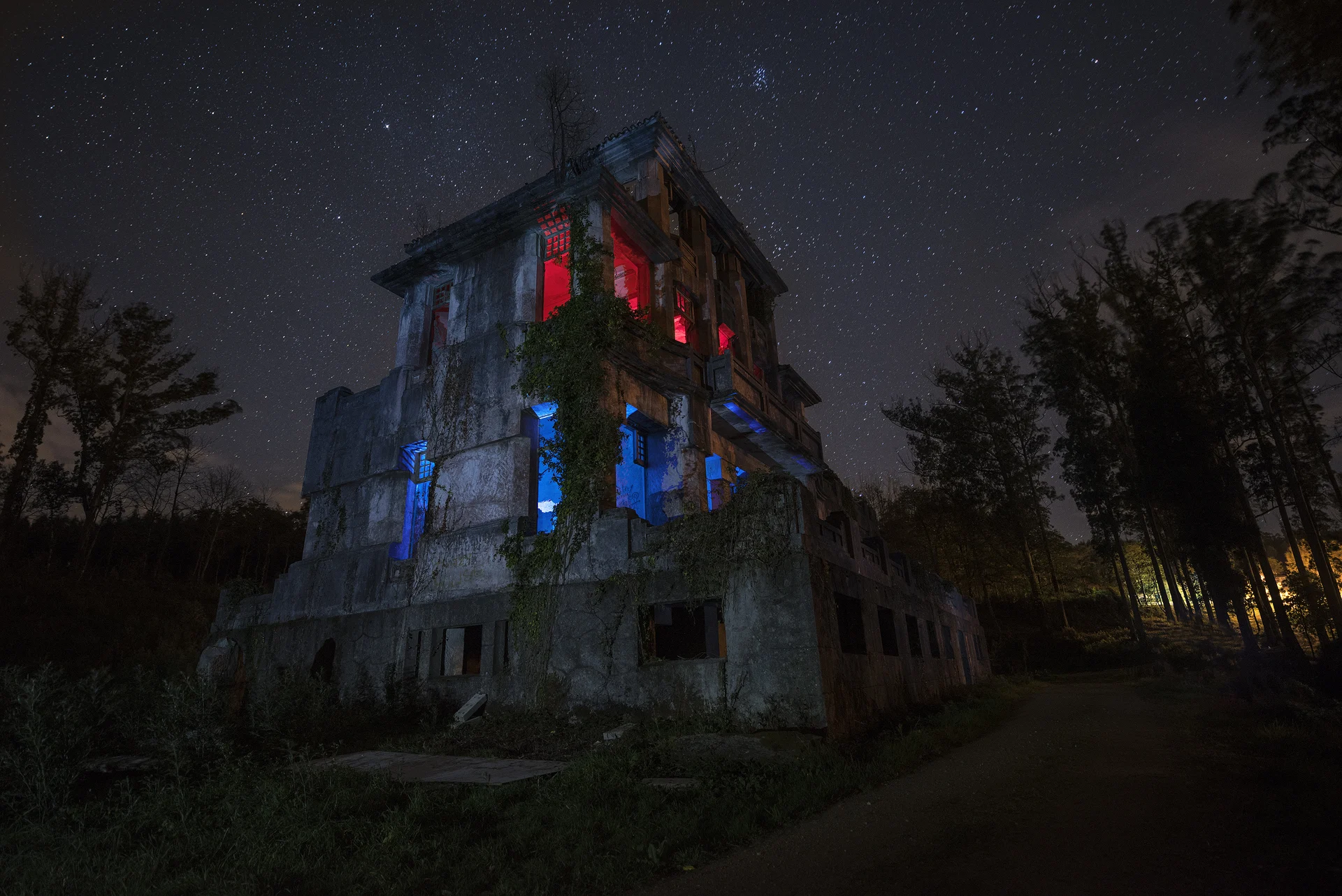
Today’s photograph was taken with two of my night-photography companions, Carlos Fornos and José Antonio García Torrado. The location is an abandoned sanatorium between Oza dos Ríos and Cesuras, in the province of A Coruña. Although it may look very dilapidated and about to collapse, from inside the structure appeared fairly solid, though we had to watch out for holes and debris on the floor.
For locations like this, visiting during daylight helps assess their condition and identify dangerous areas to avoid or take care around, because at night, while making a photograph, we often move in almost total darkness.
The aim was to illuminate the sanatorium inside and out, so we split up. One person stayed outside with the cameras to trigger them and light the exterior with a torch, while the other two each went to a different floor to add coloured lighting.
To light the exterior, we chose a cool-white torch such as a Led Lenser, and for the first floor we used a flash with a blue gel (cellophane can also be used instead of gels), while on the second floor we used another flash with a red gel.
The challenge was that we wanted the stars to appear as points of light rather than trails. This gave us no more than 30 seconds for the entire exposure, as this is approximately the longest exposure in which the stars remain still in many photographs.
We therefore set our cameras to a 30-second exposure, f/2.8 and ISO 640 to capture more light, as we had to light an entire building in very little time.
Lighting the exterior was the hardest part. We needed to shine the torch from a slight angle to bring out texture in the walls and surrounding plants. Areas farther from the camera needed more light to avoid underexposure. After lighting the building from the left, we had to move quickly to the right to illuminate it from there too.
The greatest challenge was achieving lighting that was as even as possible because in most attempts we overexposed some areas while others remained dark. After several tries, we chose this result, which we liked best and which conveyed the eerie atmosphere we wanted.
I hope you enjoyed this article. I will share more like it soon.