Portfolio
Behind the image: Immensity
During lockdown a few months ago, I spent some of my spare time looking for new locations to photograph the Milky Way as soon as possible. One place…
 By Julio Castro5 min read
 PLANNING
During lockdown a few months ago, I spent some of my spare time looking for new locations to photograph the Milky Way as soon as possible.
The Sierra de Gredos caught my attention. I had seen almost no night photographs from there, especially of the Milky Way, so I initially set it aside, assuming it was not suitable.
In June, my friends Ignacio Municio, Felipe Souto and I had the chance to spend a couple of days photographing around Spain. Our first choice was Picos de Europa, but a poor weather forecast changed our plans. My good friend and photographer Adrián Vázquez recommended the Sierra de Gredos, where he had found good night photography opportunities.
As it was already on my list, we decided to hike to Laguna Grande de Gredos, around seven kilometres each way.
The route began at Plataforma de Gredos, which was packed that June Saturday with people enjoying nature after months of confinement.
After two and a half hours, tired from steep climbs and heavy packs, we reached the lake and established our base just in time for a few sunset photographs by the water.
Before starting our night photography, we checked our apps to see whether the Milky Way’s galactic centre would be visible. The lake sits within an impressive cirque of mountains that blocks much of the sky.
After dark, with the moon still setting, we took panoramas from the lakeshore and confirmed that the galactic centre was fully visible above the peaks.
TAKING THE PHOTOGRAPH
Later, we climbed over rocks towards the other side of the lake and found an elevated spot. From there, almost the whole lake was visible, with the galactic centre perfectly reflected in the water.
To add a human element and contrasting colour, Ignacio climbed down to some rocks by the water and posed with a torch.
For this panorama, I took five photographs at 14 mm, each at 25 seconds, f/2.8 and ISO 6400. Ideally, I would have used one exposure for the sky and a longer, lower-ISO exposure for the land to reduce noise. However, as we had to take turns shooting the panorama, there was not enough time.
Humidity added another difficulty: my lens kept misting up, causing flare around the bright parts of the image, as you can see in the RAW file.
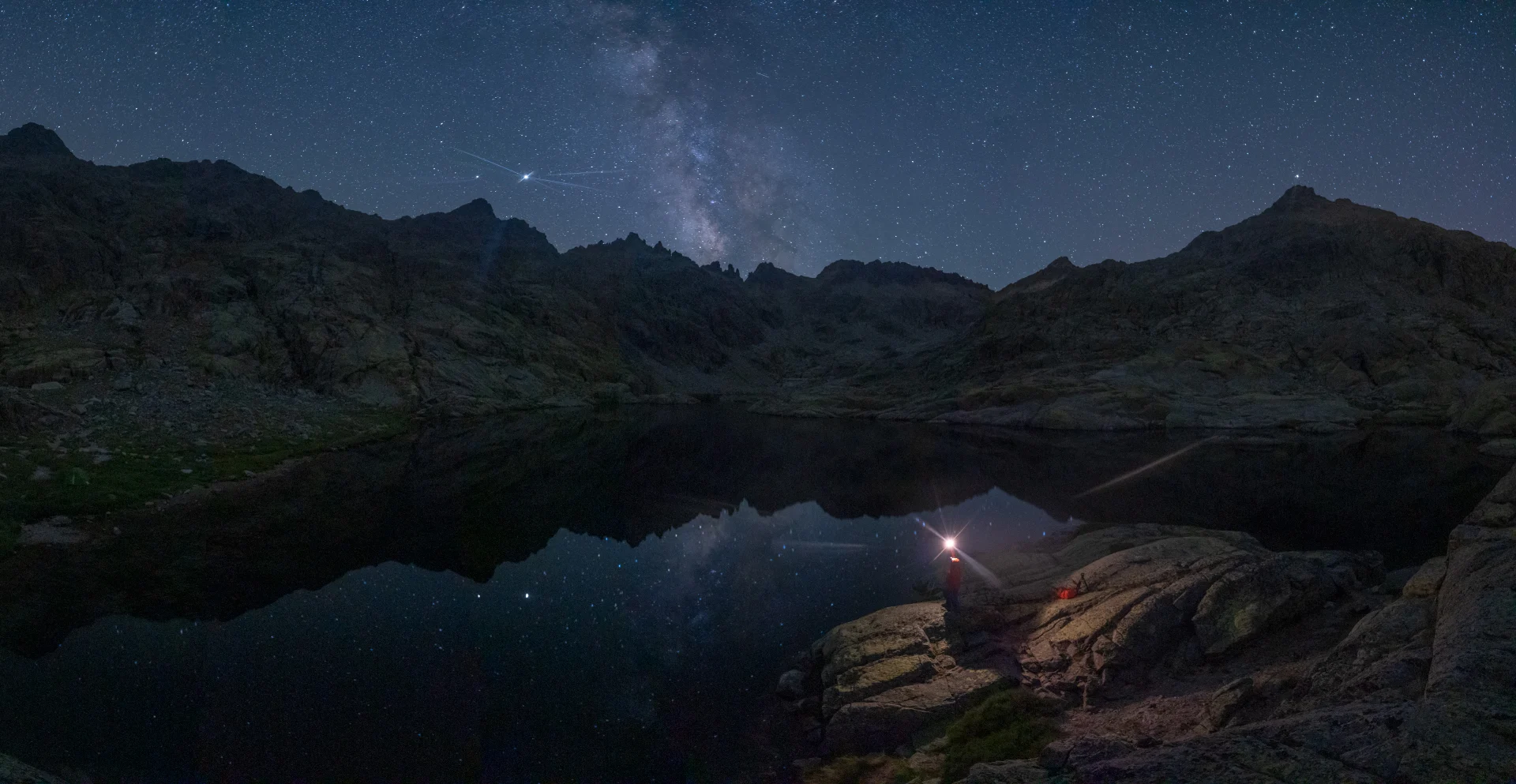
It was fortunate we worked quickly: about 15 minutes later, a breeze broke up the spectacular reflection and made the scene much less striking.
POST-PROCESSING
I stitched the panorama in Photoshop’s Camera Raw.
I then made a gentle RAW edit, focusing on reducing the noise that appeared when I lifted the shadows.
Before editing further, I removed the distracting flare caused by the misted lens and cloned out a few things, including the red backpack.
The rest followed my usual night photography workflow: editing the sky separately, with special attention to the Milky Way, then the land. I also used the Noiseware plugin to reduce noise further before final sharpening and compression.
IF YOU WOULD LIKE TO LEARN THE EDITING TECHNIQUES I USED HERE, THESE ARE MY TWO MILKY WAY EDITING TUTORIALS:
LOCATION